Importing baby diapers is a lucrative business, but choosing the right product and supplier can be overwhelming. With different core technologies, sizes, packaging options, and quality certifications, how do you make the best decision for your market? In this guide, we break down everything you need to know.
1. Understand the Three Core Types
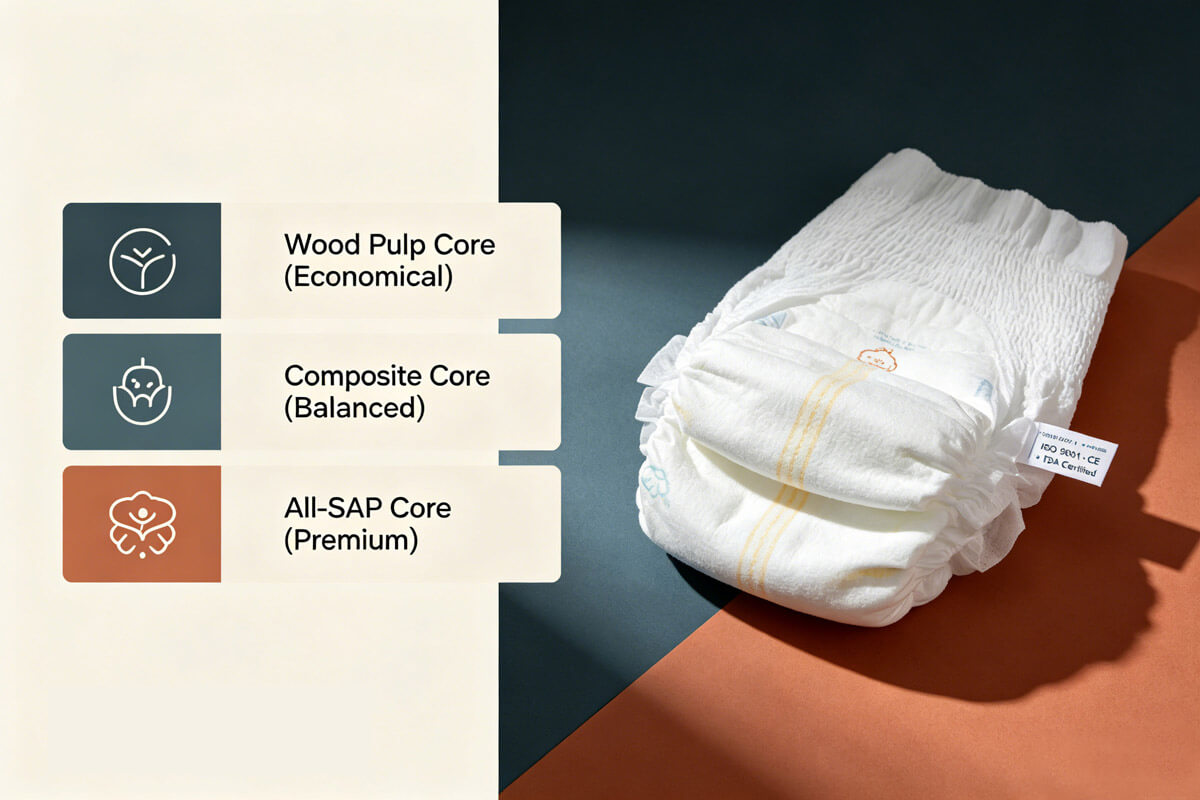
The absorbent core is the heart of any diaper. Based on your target price point and performance expectations, you can choose among three main options:
- Wood Pulp Core (Fluff Pulp) – Traditional, thick, economical. Best for budget markets where high absorbency is less critical.
- Composite Core (Pulp + SAP) – Balanced performance, good absorption at moderate cost. Ideal for most emerging markets.
- All-SAP Core (Ultra Thin) – Premium, ultra-thin, super absorbent. Perfect for developed markets or where consumers expect high quality.
We recommend ordering samples of each core type to test in your local environment. Contact us for free samples →
2. Match Sizes to Local Demographics
Baby sizes can vary by region. While standard size charts (S, M, L, XL) are widely used, we suggest checking average weight ranges in your country. For example, Southeast Asian babies may need XL for lower weights compared to European babies. Always request a size chart with actual measurements.
3. Packaging – Neutral, White Label, or Custom Print?
Your packaging strategy impacts brand perception and cost:
- Neutral packing – Plain bags with no branding. Lowest MOQ, ready stock available.
- White label – Your logo printed on standard bag design.
- Full custom printing – Unique bag design, multi-color printing, high MOQ required.
For new importers, we suggest starting with neutral or white label to test the market, then upgrading to full custom once you have steady orders.
4. Key Certifications for Export
To sell in different regions, ensure your partner factories hold relevant certificates:
- ISO 9001:2015 – Quality management system (baseline).
- CE Mark – Required for EU markets (medical device classification for incontinence products).
- FDA Registration – For selling in the United States.
- SASO – Saudi Arabian standards.
- SGS Test Reports – Third-party verification of absorbency, rewet, and microbial safety.
At KAIRUI, all our partner factories maintain these certifications, and we can provide test reports upon request.
5. Minimum Order Quantities (MOQ) & Lead Times
Most diaper factories require 1x20GP (about 1,000–1,500 cartons) for custom printing. However, for neutral packing, we offer stock with MOQ as low as 200 cartons per size. Lead times: samples 3–7 days, mass production 15–25 days after sample approval.
6. Payment & Incoterms – What to Expect
Standard terms for hygiene products from Quanzhou:
- 30% deposit by T/T, 70% balance against B/L copy.
- L/C at sight for regular bulk orders.
- FOB Xiamen/Quanzhou is most common; EXW, CFR, CIF also available.
Always clarify who arranges shipping and insurance. We recommend FOB for first-time orders to maintain control over logistics.
7. Quality Control – Don’t Skip Pre-Shipment Inspection
Even with a reliable supplier, it’s wise to conduct a pre-shipment inspection. We offer third-party SGS inspection at the factory before loading. Key checkpoints: absorbency, leak guards, tape adhesion, packaging seal, and carton strength.
8. Hidden Costs: Storage & Warehousing
Diapers are bulky and have a shelf life (typically 2–3 years). Consider local warehousing costs before ordering a full container. Some suppliers offer consolidated shipping for mixed products (e.g., diapers + wipes) to fill a container, which can lower your logistics cost per unit.
🎯 Quick Checklist for Importers
- ✔ Define your target price and absorbency level
- ✔ Request samples of all core types
- ✔ Verify certifications (ISO, CE, FDA, SASO)
- ✔ Compare MOQ and lead times
- ✔ Plan packaging: neutral, white label, or custom
- ✔ Arrange third-party inspection
Why Partner with KAIRUI?
As a trading company based in Quanzhou – China's largest hygiene products cluster – we work with multiple certified factories to offer you the best combination of price, quality, and flexibility. We handle quality control, export documentation, and shipping coordination. Your only job is to grow your market.